
Traffic Case Records in Eagle County
One traffic stop in Eagle County can create two very different court records. State charges usually land in Colorado County Court under the T case class, while a municipal citation stays with the town court that wrote it. The citation names the agency and the court. That decides who keeps the file. Location alone never moves a town case into Eagle Combined Courts.
The state public docket is mostly a hearing calendar. It lists a traffic date, time, duration, hearing type, location, appearance mode, courtroom, and case number. A paid vendor register goes further and shows case events in order. The real ticket, any orders, dispositions, and certified copies live with the filing court. Treat these layers as separate tools, not one complete online file.
| Traffic matter | Record keeper | Starting channel |
|---|---|---|
| State traffic case | Clerk of Court, Eagle Combined Courts | State docket or court phone |
| Municipal citation | Issuing town's municipal clerk | Town court page or clerk |
| Filed traffic document | Court that filed the case | Document request or counter |
Eagle County Traffic Court Routing
State traffic infractions and offenses belong to County Court. The municipal courts in Avon, Eagle, Gypsum, Red Cliff, and Vail handle their own ordinance and traffic matters. Each runs on separate tracks. Basalt state payment searches sometimes show up under the "Eagle County or Eagle County/Basalt" option. That label does not prove any Basalt citation is a state case.
Unsure of the routing? Compare the court name on the citation with the search result before you pay. Every town runs things a bit differently. The Gypsum Municipal Court page shows how a town runs its own local channel. The right clerk depends on who issued the ticket, not just the Eagle County location.
Eagle County Traffic Ticket Lookups
For a state citation, open the Eagle-filtered Judicial Branch Docket Search. Set County to Eagle County, pick the likely courthouse, choose County Court, and enter the T class with the year and sequence if you know them. The form demands at least one filter besides the date. A party-name search works, though a case number is far more exact.
The Colorado Judicial online payment search takes a case number, ticket number, or name. Remember it is a payment route, not a full docket. If the state tools come up empty, call Eagle Combined Courts at 970-328-6373 or stop by the Justice Center counter. Ask about older files and any public terminal. Municipal tickets mean calling the issuing town. For a specific state court document, mail a request or use the statewide online record form.
- Read the citation for the named court and deadline.
- For a state matter, search Eagle County with case class T or the complete case number.
- For payment lookup, select Eagle County or Eagle County/Basalt and choose case, ticket, or name.
- For a town matter, use that municipal court's official instructions or call its clerk.
- Confirm the match, court date, appearance mode, and case status before acting.
Eagle County Traffic Payment Portal
Payment starts only after the right county and search method are chosen. Enter the matching value, complete the CAPTCHA, and run the case search. Then select the case and move to payment. Review the payment details before authorizing. The system returns confirmation afterward. Auto-payments are not offered.
| Portal field | Type | Requirement or use |
|---|---|---|
| County | Dropdown | Select Eagle County or Eagle County/Basalt |
| Search method | Choice | Case number, ticket number, or name |
| Search value | Conditional text | Fields change with the selected method |
| CAPTCHA | Verification | Required before search |
| Run case search | Button | Returns matching payment cases |
| Proceed to payment | Button | Available after case selection |
| Review and authorize | Payment steps | Confirm details, submit, and wait for confirmation |
The official Colorado Judicial online payment search page displays the state tool used for eligible Eagle County traffic cases.
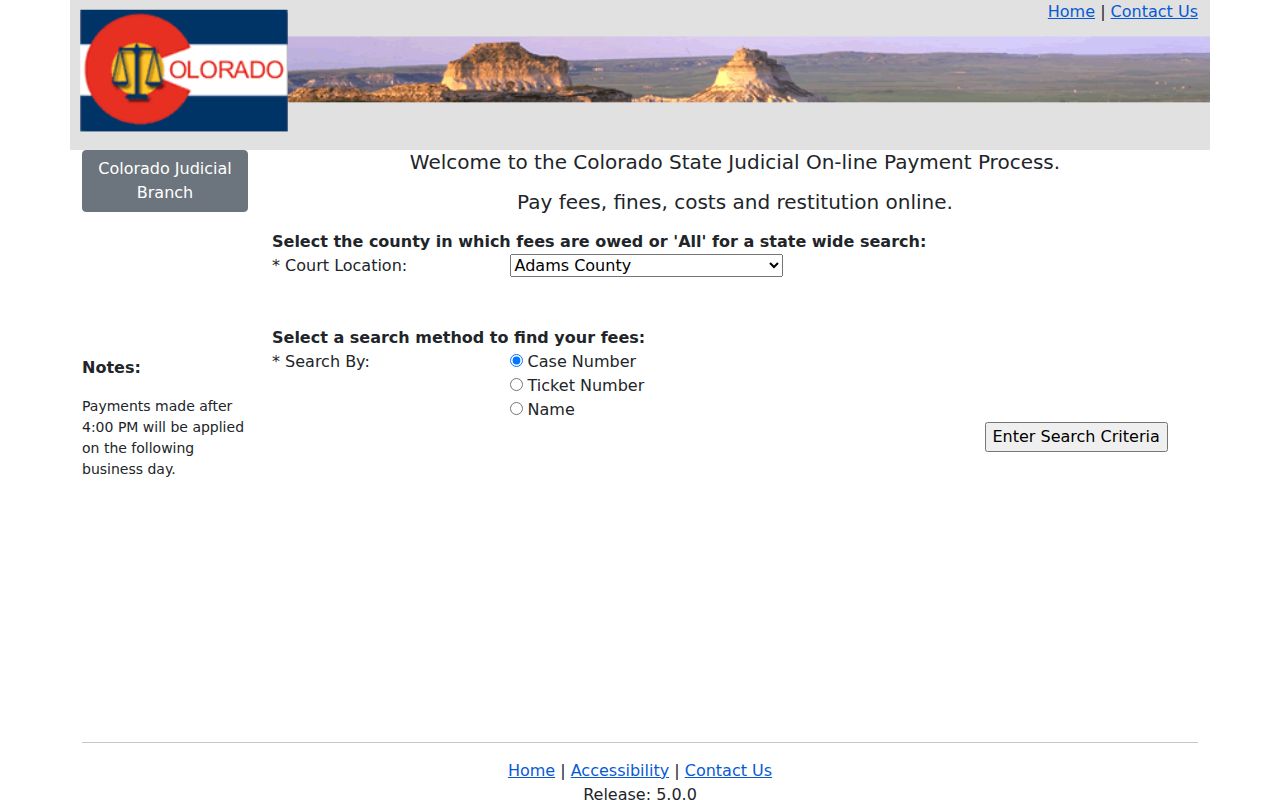
A match here confirms a payment path only. It is not a complete Eagle County traffic docket, and it is not permission to skip contest instructions.
Traffic Court Dates in Eagle County
The public docket lists the practical fields for a state traffic setting. Take a number like 2026-T-123. It blends the four-digit year, the T traffic class, and the case sequence. Match it to the right courthouse and party before relying on it. A ticket number may work in the payment portal. The docket search wants the case-number parts instead.
| Date and time | The listed start of the traffic setting; recheck shortly before court. |
|---|---|
| Duration | The calendar estimate, not a guarantee of finish time. |
| Hearing type | The kind of setting, which may include an arraignment or disposition event. |
| Location | Justice Center, El Jebel, or another named court on the citation. |
| Appearance type | In person or virtual, as shown for that setting. |
| Courtroom | The assigned room or division that controls the appearance. |
A virtual hearing still fills the courthouse and courtroom fields. Match any virtual result against the official Fifth District Webex courtroom page. Never assume a general Webex room applies.
Eagle County Traffic Arraignment Waits
Eagle's official court page calls traffic arraignments its largest-volume dockets. Many people want time with the District Attorney first. Three to four hours can pass before a judge or clerk reaches your case, so a listed start time marks when to appear, not when the visit ends.
Build in time for security. Check your appearance mode. Leave room in your schedule. If the court imposes a fine at sentencing, the Eagle County notice says it is due at that moment. Collections runs on its own service schedule and takes no phone payments, so follow the court's instructions for any balance rather than assuming the clerk can take payment by telephone.
Local timing point: arriving for the listed Eagle County traffic time does not promise immediate completion of a high-volume arraignment docket.
Paying a Ticket vs Fighting It
Paying and fighting a ticket are separate choices. Paying online may count as a disposition under the citation's terms. To contest the charge, follow the ticket and court instructions by the stated deadline. The same steps apply to any available alternative. The portal's willingness to take your money does not make payment the right choice.
| Issue | Paying | Contesting |
|---|---|---|
| Starting point | Confirm an eligible case and amount through the named court | Read the appearance or response instructions on the citation |
| Channel | Official online system or court-authorized method | Issuing court, clerk, or scheduled hearing |
| Effect | May resolve the matter under the ticket terms | Keeps the judicial issue for court process |
| Proof | Save confirmation and verify posting | Keep filed papers and current setting details |
Deadline warning: failure-to-appear and late-payment consequences depend on the charge and order; confirm them with the court named on the citation.
Never assume an alternative or a changed disposition. Eligibility, deadlines, filings, and the final order all rest with the court. When the ticket language and the portal disagree, contact the issuing clerk.
Eagle County Traffic Search Failures
A dead-end docket search often means the wrong system, not a missing case. First figure out whether the ticket is state or municipal. For a state matter, check the filters. Confirm that Eagle County, County Court, and the T class are all selected. Then try the full case number in the docket search. After that, try the ticket number in the payment system. Names alone can match several people, so check them against the citation itself.
Dates cause trouble too. The hearing may fall outside the docket's current range. It may not be set yet, or it may sit behind a restriction. Some cases simply cannot be paid online. The payment system will not show them at all. For a state file, call Eagle Combined Courts; for a town ticket, call the issuing municipal clerk. Have the ticket number handy. Add the case number if one is shown, the date, the issuing agency, and the exact record you need.
When two hearing dates appear, the later one usually reflects a reset. Old entries can linger on the calendar anyway. Only the court controls the active setting. The Eagle County court schedule details walk through calendar fields and moved settings.
Two Records: Court File and Driver File
A traffic ticket creates two separate files. One is a court docket. Eagle Combined Courts or the municipal clerk that handled the citation keeps it. The other is a driver file, held by Colorado motor-vehicle authorities. Each office controls only its own paper. So a court docket will not read like a full driving history. The driver file will never hold the court's pleadings and orders.
| Record | Custodian | What it addresses |
|---|---|---|
| Court traffic file | Eagle Combined Courts or municipal court | Citation case, settings, events, disposition, and filed orders |
| Driver file | Colorado motor-vehicle authority | Separate agency-maintained driver record |
Ask for the court file when you need to confirm which court heard the ticket, what date was set, or what order a judge entered. The clerk and the motor vehicle office each keep their own record. Neither one can certify the other's file, so knowing which record you need keeps your request accurate.
Eagle County Traffic File Contents
A traffic docket's calendar layer is the quick view. It lists the case number and the party field. The hearing type, date, time, location, appearance mode, and courtroom appear too. A paid register adds chronological events. Still, it cannot display filed documents, and it is not the official court record. The Eagle County court file goes further. It can hold the ticket, pleadings, orders, disposition papers, and financial entries that are public and available.
To request a copy, give the court, Eagle County, the case number, party details, and the filing year, and name "Ticket" or another exact document in the online request. You can ask for certification or exemplification. Restricted information can require ID or legal authority. A broad request may mean added research or redaction time.
Read calendar labels with care, because a label alone does not reveal the result. A Disposition Hearing is just an event on the docket. The signed disposition or sentence order states the outcome. In the same way, a Setting may only pick a later date rather than serve as the final trial setting.
Traffic Record Copy Fees
Eagle County traffic copy costs follow the Judicial Branch schedule. Municipal courts may set their own instructions, so confirm with the issuing clerk. Fees and postage can change, so check current materials before ordering.
| Traffic record item | Verified state-court charge |
|---|---|
| Electronic filed copy | $0.25 per page; party or attorney maximum $15, no nonparty maximum stated |
| Paper court copy | $0.75 per page on the official PDF |
| Certified or exemplified document | $20 per document plus copy cost as applicable |
| Name search | $5 |
| Research or redaction | $30 per hour after the first free hour |
| Off-site retrieval | Actual cost |
Certification carries its own charge. It authenticates one court document. It does not make the free calendar or vendor register official. Paper copies sent by mail add postage. Ask for just the ticket, order, or disposition that answers your question.
Eagle County Traffic Access Limits
Colorado court-access rules govern Eagle County traffic records. Chief Justice Directive 05-01 and Chapter 38 both apply. A remote docket result can be narrower than the courthouse file. Party contact details, victim or witness information, free-text data, and other protected material may be withheld or redacted, and sealed or suppressed matters may not appear in a public docket search at all.
Restricted material may require proof of party status, authority, or identification. An empty search does not prove no case exists. Call the clerk and name the exact record sought. Municipal cases stay under the official and rules of that court, and Eagle County administrative-record procedures never substitute for a Judicial Branch case-file request.
The working chain is simple. Try the citation first, the correct court second, and a docket or payment search third. The filing clerk holds the official document. That order keeps the court case, the payment route, and the separate driver file from blurring together.