
Eagle County Court Record Requests
One form covers requests across the state. The statewide Record/Document Request form sends your request straight to the Eagle County court holding the case, and for District Court and County Court matters that means the Clerk of Court at Eagle Combined Courts. The free docket is good for one thing: finding the court and case number. It will not hand you filed images. A paid vendor register can list dated events, but the vendor is not the official record and cannot produce the documents behind those entries.
Every documented channel has a use. File online, call 970-328-6373, visit or mail Eagle Combined Courts, or ask the clerk about older or off-site material and any public terminal. The Justice Center sits at 885 Chambers Avenue, P.O. Box 597, Eagle, CO 81631. El Jebel, at 20 Eagle County Drive, Suite B, Carbondale, offers limited service, so call ahead. Municipal records belong to the named town court. For federal documents, use PACER.
- Find the Eagle County court, county, case number, filing year, and case type.
- Name each document, with its filing date when known.
- Choose electronic, paper, certified, or exemplified form as needed.
- Submit online or contact the Eagle Combined Courts clerk by phone, mail, or counter.
- Wait for availability, cost, identification, or retrieval instructions, then pay as directed.
How long does a reply take? Colorado's web form says the Eagle County court responds within three business days absent extenuating circumstances, while an official PDF version says to allow three to five business days. Either way, the first reply may just be a quote or a follow-up question rather than the records themselves.
Eagle County Court Records Office
Colorado's combined-court structure trips people up. The Clerk of Court for Eagle Combined Courts works within the Colorado Judicial Branch. That office keeps both local District Court and County Court files. The official staff list names MaLinda Hollis as Clerk of Court and Probate Registrar. Her number is 970-328-8584. For general court operations and help locating a record, use 970-328-6373.
The elected Eagle County Clerk and Recorder is a separate office entirely. It keeps deeds, recorded instruments, marriage records, and election material. The state trial court's civil and criminal case files are not there.
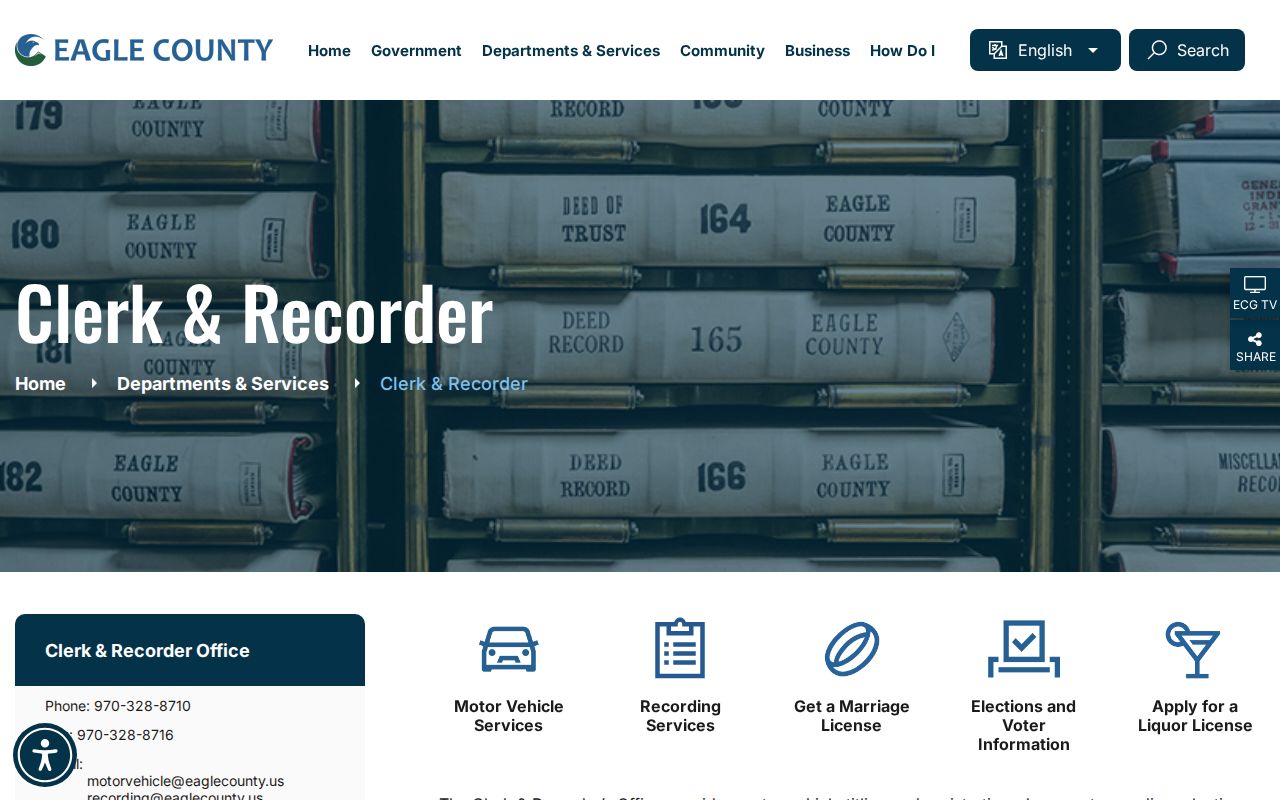
The office page shows this same split. Its listing reflects the county office's role, and a county recording search still does not replace a request to Eagle Combined Courts for a judicial file.
Clerk of Court, Eagle Combined Courts
885 Chambers Avenue, P.O. Box 597
Eagle, CO 81631
970-328-6373
District and County Court case files, official copies, settings, payments, and record requests.
Kinds of Court Records
What counts as a court record? Plenty of things. Eagle County court case records can include pleadings and orders. Judgments, decrees, dispositions, tickets, protection orders, and the register of actions fit too. A civil file may hold a complaint, answer, motion, judgment, and satisfaction. Criminal request options cover a complaint or information. The same request can seek a disposition or sentence order, a protection order, and a ticket. Domestic files may include a decree, parenting plan, separation agreement, support order, or petition.
Probate requests might name letters, a will, trust, application, petition, closing paper, or claim. Recordings and transcripts follow their own process and cost rules. Exhibits can carry special custody or release limits. Skip asking for "the whole docket." One signed order or decree may answer the need. Exact titles and dates cut down retrieval confusion and save staff research time.
Three Eagle County Court Record Layers
Three different sources can describe one Eagle County case. None of them substitutes for another. The public calendar docket shows when and where a hearing is set. A register of actions lists dated procedural events. The official case file holds the documents the Eagle County court accepted and maintains. Only the clerk's file counts as the official source.
| Layer | Best question | Access point |
|---|---|---|
| Calendar docket | When and where is court? | Free Judicial Branch docket search |
| Register of actions | What events were entered? | Fee-based vendor or clerk |
| Case-file document | What does the signed or filed paper say? | Eagle Combined Courts request |
The Judicial Branch Access Guide walks through these options and warns that vendor data can contain omissions. A vendor result never becomes the official Eagle County court record.
Court Records: What They Contain
What you get depends on what you ask for. A register is just a brief chronological account. A filed order contains the judge's actual direction. A certified copy reproduces a filed item with clerk authentication. An exemplified copy, when available and required, adds another layer of authentication. A transcript comes from a proceeding, not from a printout of docket events.
| Case identity | Case number, court, county, class, filing year, and party roles. |
|---|---|
| Register events | Dated filings, settings, orders, status changes, and disposition entries. |
| Pleadings | Complaints, petitions, answers, responses, motions, and replies. |
| Court rulings | Orders, judgments, decrees, and disposition or sentence papers. |
| Authentication | Certification or exemplification requested from the clerk. |
| Proceeding media | Recordings or transcripts obtained through a separate process. |
Remote fields can be narrower than what you see at the courthouse. Public remote data may include names, filing listings, the case number, assigned judge, county, scheduled date and location, and certain judgments or criminal case fields. Contact data, victim and witness details, free-text fields, and some financial information stay limited.
Specific Eagle County Court Record Requests
The online form asks for the basics. Expect requester contact data, court and county, case number if known, case type, filing year, party details, and a description of the record. It includes an "I don't know the County" option. Choosing Eagle County when you know it prevents routing delay. A date of birth may help identify a primary party where appropriate. Keep in mind that required identification never overrides a restriction.
Typical checkboxes include Divorce Decree, Parenting Plan, Disposition/Sentence Order, and Ticket. Order for Judgment, Transcript of Judgment, Satisfaction of Judgment, and Register of Action round out the list. You also mark whether certification or exemplification is needed. For an old file, ask about off-site retrieval. The clerk may report cost, availability, or the need for added details before making copies.
Request tip: give the case number plus the document title and filing date instead of asking Eagle County staff for every paper.
Copy Fees and Certification
Eagle County's official request materials split copy charges into categories. Format, authentication, research, and retrieval each carry a separate line. Because fee schedules change, check the live request materials before you place an order. The Judicial Branch fee page adds that many filing fees rose in 2025, but a filing fee and a copy charge are two different costs.
| Eagle County record service | Verified charge |
|---|---|
| Electronic filed-document copy | $0.25 per page; party or attorney maximum $15, with no nonparty maximum stated on the web form |
| Paper or court copy | $0.75 per page on the official PDF |
| Certification or exemplification | $20 per document, plus copy charge as applicable |
| Transcript of judgment | $25 |
| Certificate of satisfaction | $20 |
| Name search | $5 |
| Research or redaction | $30 per hour in 15-minute units after the first free hour |
| Off-site retrieval | Actual cost |
Mail a paper request and postage may apply. The official PDF lists postage bands starting at $1 for 1 to 17 pages and reaching $19 for 151 to 1,200 pages. Postal rates are subject to change. A certified copy is not just a pricier search result. It is a clerk-authenticated reproduction of an official court record.
Eagle County Court Records E-Filing Boundary
E-filing in Colorado does not open a free library of court records. Colorado Courts E-Filing takes filings from attorneys and from eligible non-attorneys. A self-represented litigant who wins approval gets limited reach. That person can access only a supported case of their own. That access also comes after opting in. The system is no substitute for a public Eagle County court records search.
Non-attorney access covers defined domestic-relations and eviction workflows. Opting into an existing case can take up to two business days. The service fee runs $12 per accepted filing. E-service to another CCE account adds $12. Other statutory charges stay separate. Those filing costs sit apart from the clerk's document-copy fees.
Colorado's e-file security labels also describe access, not lasting public visibility. Public, Protected, Restricted, Suppressed, and Sealed each follow different rules. No label guarantees that any requester can obtain the item.
Access Rules for Court Records
Colorado court records answer to Chief Justice Directive 05-01. They also answer to Chapter 38, Public Access to Information and Records. Criminal court records add another layer: the Colorado Criminal Justice Records Act. That statute's custodian and denial provisions sit in sections 24-72-304 and 24-72-305. Juvenile access turns chiefly on the Children's Code and the directive.
Colorado Open Records Act requests often cover executive or local administrative records. They are not the sole route to state Judicial Branch case files.
Expect gaps in sealed, suppressed, juvenile, adoption, mental-health, and protected-person material. An authorized party may need a government photo ID. Attorney credentials, written authority, or a court order may also be required. Colorado Criminal Rule 55.1 treats criminal court records as presumptively public. At the same time, it allows a court to limit access. Restriction changes who may see a record, not whether it still exists.
Eagle County Court Records Custodian Check
Every record type has its own keeper. Eagle Combined Courts holds the local District and County Court files. Municipal clerks keep ordinance and municipal-traffic cases, while Eagle County departments answer administrative public-record requests. Recorded instruments live in the Clerk and Recorder's Acclaim portal. Federal matters go to the U.S. District Court for the District of Colorado. Access runs through PACER and CM/ECF.
The split matters most when a docket search works. The paper you want may still be missing. Go back to the Eagle County court named on the case. A municipal citation does not belong at Eagle Combined Courts by default. A deed does not come from a Judicial Clerk. A federal docket entry belongs in PACER. Matching the item to its custodian spares you false "no record" answers and needless fees.
Call Eagle Combined Courts before driving to El Jebel or asking for an older file. That location runs a limited schedule. The Justice Center reports weekday hours plus recurring late-day counter closures for staff meetings. Confirm current service hours on the official Eagle County court page.